Irish Independent - Breaking News
Saturday June 30 2007
Pro-choice campaigners staged a rally in Dublin's city centre today calling for a range of reproductive rights for women, including abortion.
Over 120 thousand Irish women have travelled to the UK to terminate their pregancies since 1990.
A recent M-R-B-I poll found that more than half of people aged between 18 and 25 are favour of abortion on request.
"The rally today is about calling for all sorts of reproductive rights - mainly for the right of women to access abortion services in Ireland," said Sinead Ahern of Choice Ireland.
Saturday 30 June 2007

Thursday 28 June 2007

Pro-choice groups call for new legislation on abortion
The Irish Times
Thursday 28th June 2007
Carl O'Brien
Thursday 28th June 2007
Carl O'Brien
Pro-choice groups have called on the Government to legislate for abortion in Ireland in response to the large number of women who travel abroad to terminate their pregnancies.
Last year 5,042 women gave Irish addresses at abortion clinics in Britain, according to the UK's department of health.
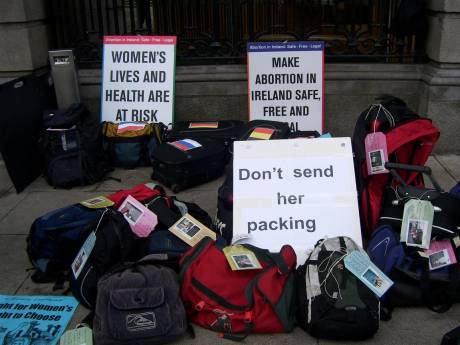
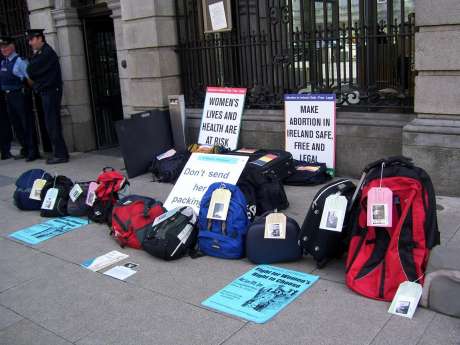
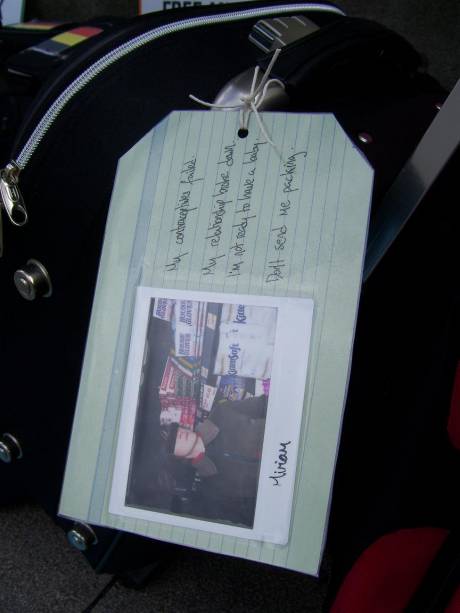
In order to highlight those numbers, Choice Ireland yesterday displayed 20 suitcases and rucksacks outside Leinster House to signify the 20 women who leave Ireland each day for an abortion.
Sinead Ahearn, a spokeswoman for Choice Ireland, said the real numbers of women travelling abroad were much greater as official figures do not include those travelling to other countries such as the Netherlands, Belgium and the US to terminate their pregnancies.
She pointed to a recent TNS/ mrbi poll, commissioned by the Irish Family Planning Agency, which indicated significant support for abortion in Ireland in certain circumstances. It found 43 per cent of people supported abortion if it was in a woman's "best interests", but the majority (51 per cent) remained opposed to it in this country.
Choice Ireland will hold a rally on Saturday at the Central Bank Plaza at 2pm as part of its ongoing campaign for abortion rights.
Wednesday 20 June 2007
Fight For Women's Right to Choose!
Choice Ireland will hold a Pro Choice Rally at 2pm on Saturday 30th June at Central Bank Plaza, Dame St, Dublin 2. The theme of the rally is "Fight for Women's Right to Choose".
Confirmed Speakers include Sen. David Norris and Ivana Bacik.
Please pass on these details to anyone you think might come along.
Hope to see you there!
What do we want?
Confirmed Speakers include Sen. David Norris and Ivana Bacik.
Please pass on these details to anyone you think might come along.
Hope to see you there!
What do we want?
- Free Access to Accurate Information on All Crisis Pregnancy Options
- Legislation Regulating Information Provided by Crisis-Pregnancy Centres
- Immediate Legislation for the X and C Cases
- Proper Sex-Education
- Free Access to Multiple Forms of Contraception Including the Morning-After Pill
- Free and Legal Abortion on Demand
- High-Quality Post-Abortion Care
- End to Stigma Surrounding Abortion
- Practical Support for Women Seeking Abortion
- End to Stigma Surrounding Sexual Health and Contraceptive Needs
- Increased Support for Single and Low-Income Parents
- Increased Protection for Working Mothers
- Free Access to Quality Childcare
- End to Stigma Surrounding Single Parenthood
- Choice in the Method of Childbirth
- Creation of More Feminist Health Centres
Monday 21 May 2007
Babies, Storks and the Academic Dishonesty of the Anti-Choice Lobby
 A recent advertisement circulated in Irish print media by the anti-choice group, “Pro Life Campaign”, is a striking example of the manipulative and unethical tactics the anti-choice lobby are willing to embrace. The ad, spotted originally by Choice Ireland in the Dundalk Democrat, encourages citizens not to give their vote to parties that have given a commitment to introduce abortion legislation. It founds this request on the claim that, “Support for abortion ignores the dignity and humanity of the unborn child and the most recent findings showing the negative effects of abortion on women (Journal of Child Psychology and Psychiatry, January 2006).”
The above citation to the reputable Journal of Child Psychology and Psychiatry is an obvious attempt to create an impression of academic and scientific support for the oft-cited (but scientifically insupportable) anti-choice assertion that abortion “has negative effects on women”. In fact a basic examination of the article cited merely demonstrates the extent to which the anti-choice agenda are willing to misrepresent facts and embrace academic dishonesty in an effort to garner support for their agenda.
The first point to be made here is that the journal article is mis-referenced and misrepresented at the most basic level. The article in question makes no reference to the notion that “abortion ignores the dignity and humanity of the unborn child”. Neither does the article find “negative effects of abortion on women”.
What the journal article does say is, “The findings suggest that abortion in young women may be associated with increased risks of mental health problems" (Fergusson et al, 2006, 16). The important word here is "associated". This is not the same as "showing the negative effects of abortion on women". What it specifically means is that the authors found a statistically significant relationship (at the Alpha level of below .05) between having an abortion and the presence of the specific mental health indicators they looked for. That by no means indicates or provides evidence for cause. Only correlation. This is a subtle but vital difference.
In order to elucidate the vital distinction between correlation and causation, statisticians often cite the following example. If you examine the records of the city of Copenhagen for the decade following World War II, you will find a strong positive correlation between the annual number of storks nesting in the city, and the annual number of human babies born in the city. Jump too quickly to the assumption of a causal relationship, and you will find yourself saddled with the conclusion either that storks bring babies or that babies bring storks.
In fact what you have here is a situation where the two variables (or things) being examined are correlated (or associated), not because one is causing the other, but rather because both are influenced by a third variable, that is not being taken into account. During the decade following World War II, the populations of most western European cities steadily grew as a result of migrations from surrounding rural areas. Additionally this was the post-war baby boom era. Copenhagen is also home to annually fluctuating numbers of storks. As population increased, there were more people to have babies, and therefore more babies were born. Also as population increased, there was more building construction to accommodate it, which in turn provided more nesting places for storks; hence increasing numbers of storks.
The findings of this research cannot be used to assert causation, only correlation. Abortion does not cause mental problems, it is "associated" or "correlated" with it. The study itself goes into the limitation of this in the discussion section. What it means methodologically is that, while confounding factors were taken into account (third factors that might influence the results), there is the possibility that other confounding factors which were not controlled for have not been taken into account and the association is a result of a third factor. Pointedly, the research did not control for existing psychiatric illness. It is quite possible that this, or any other factor not controlled for is creating a “confounding” association similar to the one between babies and storks.
The research itself also suffers from a variety of methodological problems which impose very serious limitations on the already weak finding that, “abortion in young women may be associated with increased risks of mental health problems”. Indeed the word “may” in this sentence already indicates the extent to which this is an unfounded hypothetical possibility, rather than a definitive evidence based reality.
Perhaps the most striking limitation to this research is the fact that it was conduced in New Zealand. In New Zealand, the provision of abortion is determined by the Contraception, Sterilisation and Abortion Act, 1977.The Act requires that certain criteria are met before allowing a woman to undergo an abortion. In order to have an abortion in New Zealand, two certifying consultants must agree: 1) that the pregnancy would seriously harm the life, physical or mental health of the woman or baby; or 2) that the pregnancy is the result of incest; or 3) that the woman is severely mentally handicapped. An abortion will also be considered on the basis of age, or when the pregnancy is the result of rape. Given the implications of these criteria in terms of the mental health of women who are allowed to have an abortion in New Zealand, it is hardly surprising that the study should find some association between women with negative mental health indicators and abortion. Given the circumstances in which the pregnancy must take place, the presence of negative mental health indicators is almost required to have an abortion in New Zealand.
This is by no means the only methodological problem. Importantly, the sample of people that was used for the research may have been biased since it does not match the real population in New Zealand. Specifically the people that were sampled had a lower reported rate of abortion compared to the real population. We would always expect some difference in terms of populations, however as the study itself points out, this difference was statistically significant, (Fergusson et al, 2006, 17). This poses serious problems in terms of the validity of the research since certain types of people may be more likely to admit to having had an abortion. If this is so, the sample will be biased and the results may be invalid.
Another profoundly serious problem, which the article itself points out, is that the research took no account of the role of contextual factors. As the article itself makes patent, " It is clear that the decision to seek (or not seek) an abortion following pregnancy is likely to involve a complex process relating to: a) the extent to which the pregnancy is seen as wanted; b) the extent of family and partner support for seeking or not seeking an abortion; c) the woman's experiences in seeking and obtaining an abortion. It is possible, therefore, that the apparent associations between abortion and mental health found in this study may not reflect the traumatic effects of abortion per se but rather other factors which are associated with the process of seeking and obtaining an abortion. For example, it could be proposed that our results reflect the effects of unwanted pregnancy on mental health rather than the effects of abortion per se on mental health.” (Emphasis added, Fergusson et al, 2006, 22)
Owing to these limitations the real conclusions of the report are as follows:
"On the basis of the current study, it is our view that the issue of whether or not abortion has harmful effects on mental health remains to be fully resolved." (Fergusson et al, 2006, 23)
"Notwithstanding the reservations and limitations above, the present research raises the possibility that for some young women, exposure to abortion is a traumatic life event which increases longer-term susceptibility to common mental disorders.” (Emphasis added. Fergusson et al, 2006, 23)
"These findings are inconsistent with the current consensus on the psychological effects of abortion.”
The findings of this research are indeed out of step with the current consensus on the psychological effects of abortion. This is most likely due to the profound methodological limitations of the research as discussed above. In fact there has been much research on this issue and the consensus is that there is no link between abortion and psychological harm to women. The highly reputable and prestigious American Psychological Association outlined this in their 2005 statement on abortion. It concluded that “well designed studies of psychological responses following abortion have consistently shown that risk of psychological harm is low … the percentage of women who experience clinically relevant distress is small and appears to be no greater than in general samples of women of reproductive age” (American Psychological Association, 2005)."
This is not to deny that abortion is a difficult event for many women. Abortion is a hard choice for all women and one, which no woman chooses lightly. But for some women it is their choice. And with quality counselling to explore their decision prior to making it, it is a choice they rarely regret (IFPA, 2000).
What can be particularly traumatic for women in Ireland facing crisis pregnancy, is the fact that they are forced overseas to avail of an abortion. As women in crisis pregnancy in Ireland are exported abroad the reality of their situation and the decisions they must face are blatantly denied and their choice stigmatised in a way that can only compound the anxiety of a crisis pregnancy. Moreover women who choose an abortion are faced with the enormous financial burden incurred from travelling abroad. A statement by the Royal College of Obstetricians and Gynaecologist is particularly salient in this regard. “Only a small minority of women experience any long term psychological squeal after abortion. Early distress, although common, is usually a continuation of symptoms present before the abortion. Conversely, long lasting, negative effects on both mothers and their children are reported where abortion has been denied.” (Royal College Obstetricians and Gynaecologists, 2000).
If those who maintain the anti-choice agenda are truly concerned about the psychological welfare of women they might examine the academic consensus on the issue instead of misrepresenting it. Each year between 6000 and 7000 women from Ireland travel to Britain for an abortion. Abortion is a choice women will continue to make. It is also a right that they must be allowed to exercise over their own bodies. It is the absence of abortion rights in Ireland, which is damaging to the psychological well being of women.
The anti-choice lobby claims to be interested in the psychological well being of women and in reducing the numbers of abortions. This interest will not be served by misrepresenting academic research or by manipulating women. Neither will it be aided by denying women their right to an abortion in Ireland and compounding the crisis of their pregnancy. It will be served through legislation legalising free abortion; the introduction of adequate sex education programs; an end to the stigma surrounding sex and abortion; free and accessible contraception and the introduction of real supports for women who choose to go through with their pregnancies. If the anti-choice lobby are truly interested in the psychological well-being of women and reducing the numbers of abortions, the reality is that they would be better served turning their energies towards these issues.
Tuesday 15 May 2007
Ah, the joys of knowing that you're always right
Ah, the joys of knowing that you're always right
by Ian O'Doherty,
One of the interesting scabs reopened by the Ms D debate has been the bafflement felt by many people at the utter refusal of some religious people to even consider the possibility that it might actually be a kindness - rather than a mere convenience - to terminate the pregnancy of a foetus which will be ultimately born without a brain.
An interesting example of this mentality arrived in the ISpy inbox yesterday, and sat there smugly until it was eventually opened. And these are its words of wisdom: "Isn't more natural to let nature take its course? Who knows, the child might not be as badly affected as the medics predict."But even if the child is going to die, then after the natural term, he or she will die naturally without the recourse of some 'surgeon' tearing it to pieces limb from limb... how sick is that. Women have the right to be protected from abortion, as have their children."Since when does killing innocent and defenceless children become merely an option, a choice? God have mercy on us all."
And these are interesting points, so let's deal with them. Should we just let nature take its course?Applying that logic, the last Pope would have been dead 10 years sooner had his medical team not done so much to stop nature taking its course.
And as for "protecting women from abortion", the last time any of us heard a man talking about protecting women from making their own decisions came from the Taliban. Not that there's much difference between that lot and some of the more excitable fundamentalists in this country.
http://www.unison.ie/irish_independent/stories.php3?ca=45&si=1829239&issue_id=15618
Wednesday 9 May 2007
Choice Ireland calls for no more “X” “C” or “D” Cases
Choice Ireland commends today's verdict in favour of “Miss D”s right to travel for an abortion. Nevertheless we are appalled by the treatment “Miss D” has received at the hands of our state. It is unacceptable that yet another woman has been dragged through the courts in order to vindicate her rights and her choice. It is also unacceptable that “Miss D” will now be forced overseas in order to exercise her choice to have an abortion.
Today is not a joyful day for Miss D. While she has finally gained the right to exercise her choice, she had to go through a lot to get to this point. She now has to face into the reality of an abortion. She must do this overseas away from the support of family and friends. She must then return to this country which, because it ignores the problem, has no proper free post-abortion care or counselling available. This is the situation for thousands of Irish women.
The abortion issue must be resolved. Without legislation to clarify the ambiguous legal position with regard to abortion, women like “Miss D” (as Miss “X” and Miss “C” before her) will continue to be dragged through the courts. Meanwhile due to the State's failure to face the reality of tragic crisis pregnancy, 17 Irish women a day have the anguish of their situation compounded by the financial and emotional burden of being forced overseas for an abortion. The current position represents a "head in the sand" approach to a reality faced by thousands of women in Ireland each year and is incompatible with any notion of respect for women.
Choice Ireland are today calling for no more "X", "C" or "D" cases, for the repeal of the 8th amendment and for free, safe and legal abortion to be made available in Ireland.
Subscribe to:
Posts (Atom)